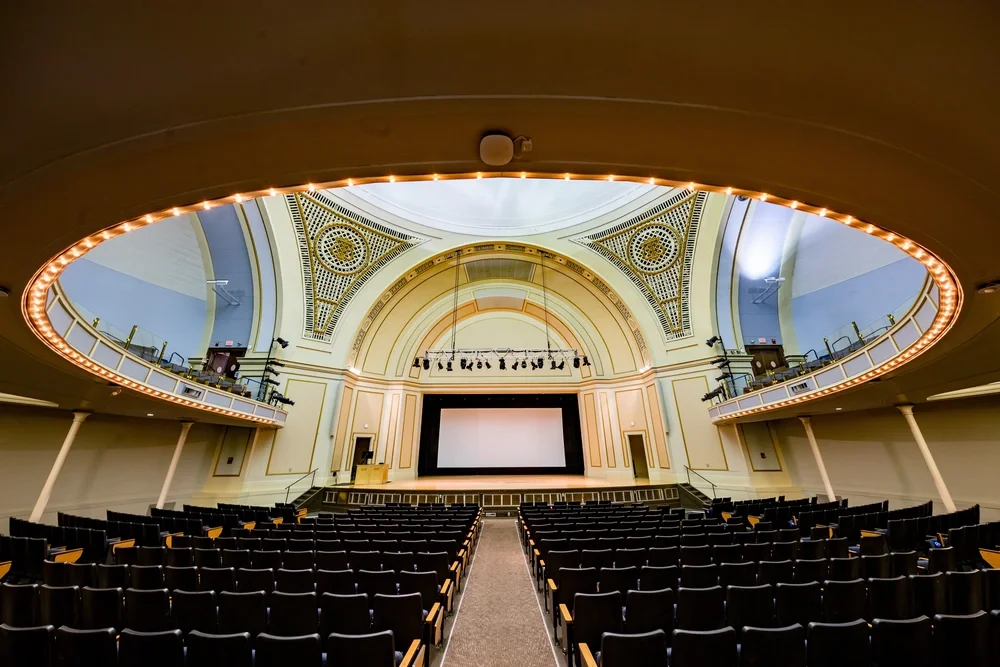
Despite its name, the School of Molecular & Cellular Biology rarely deals in small quantities, and no two people know that better than Drs. Michael Garcia and Ana Belen Ramos Hryb. Garcia and Hryb are the instructors for MCB 244 - Human Anatomy & Physiology: one of the university’s largest classes with 830 available seats. As of writing, eight sit unoccupied.
The School of MCB sat down with Garcia and Hryb right before the fall 2026 semester to discuss their first year teaching at MCB, “Grey’s Anatomy,” and how learning about the body can expand the brain.
This conversation has been edited for length and clarity.
MCB: Dr. Hryb, you moved in only a few months ago. Dr. Garcia, you’ve been here for about a year. How does it feel moving and immediately being asked to teach one of the largest classes at a Big Ten university?
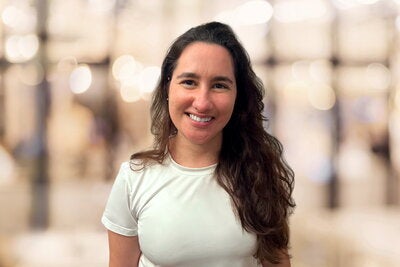
Dr. Ana Belen Ramos Hryb: It’s very exciting. I will admit, when I read 800/900 students, I thought, “What an enormous challenge.” But also, it’s so cool because I got to ask myself how I’m going to make this class interesting. When you’re teaching this many students, you need to put in the extra effort to keep them engaged.
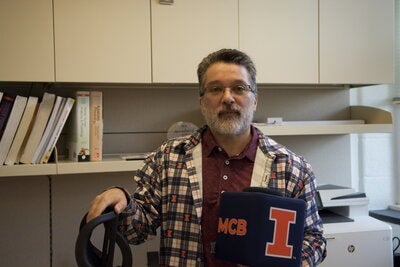
Dr. Michael Garcia: The largest class I taught at the University of Missouri was 200. And so, at one level, it’s just a few more sets of eyes. What I wondered about most were logistical things. How are you going to give an in-person final to 600 to 800 students? What made it less daunting is the teaching assistants and instructional program office are phenomenal. So what was, “Oh my gosh, how am I going to do this for 600 people?” became “Yeah, it just gets done because they’re so good.”
MCB: How has being a researcher made each of you better teachers?
AH: I actually collaborated with Michael’s PI, Dr. Don Cleveland, when I worked in biotech. I’ve been exposed to so many things and so many people. I think what makes you a very good teacher is not just from how you present your ideas, but how you advise students with different backgrounds who might have different ideas for their careers.
MG: Well, I started teaching at a time when most people don’t — that is, during my postdoc. And when I got my own lab, I would always ask people, “Who exactly do you want to communicate to? Do you want to communicate your science to people in this lab or as many people as possible?” It’s all about taking complex ideas, getting to the heart of them, and making them understandable. Research and teaching definitely helped each other in that way.
MCB: If there was one thing you’d want students to take away from your course, what would it be?
MG: The challenge, especially with pre-health students, is all about trying to give the students the information they need and to help them understand why it’s valuable. I find it an interesting and fun challenge to get them to understand the material, and start linking material.
Nothing exists in isolation in our bodies, right? So, we’re trying to get them to think across systems rather than just memorize one in particular. I would rather have students who can think and reason rather than memorize. I would always tell people in my lab, “Educated people don’t know a lot of facts, they just know where to find them.”
MCB: Things are rapidly developing in the life sciences. What has changed in this field in the last, let’s say, five years? How has that impacted what you teach?
AH: We can start with books, if you really need those anymore. It used to be that you had to learn first as a teacher and then translate for the students and teach them how to find the correct sources. But now, you can open Google and ask, “How is the cranium organized?” Things evolve so fast that one challenge for us is to be ahead of the change, including AI. We need to learn how to use AI in a proper and responsible way.
MG: For me, I was looking into different universities in the US, especially the Ivy Leagues. All of them use 3D imaging. Back when I was learning neuroanatomy, you used this big spiral-bound atlas. And that was your Google, right? They were always just flat pictures.
There’re tools out there that are great at depicting three-dimensional body structure. I use 3D images because they’re just so powerful. So, getting that incorporated into our classroom is a challenge but it’s also very worth it. It’s all changed, even small things, like convincing students that Gray’s Anatomy was actually a textbook and not a TV show.
MCB: Is that true?
MG: Yeah, it used to be the anatomical textbook for medical schools. I have a copy of it somewhere.
MCB: When you see fake science in movies, do you roll your eyes or go along with it?
MG: I quietly roll my eyes and I try not to ruin the movie for anyone else. But it drives me insane because it’s not like you can’t pick up a phone and call a scientist. You can get consultants to help you through these things.
AH: I think movies are very cool and I like the idea of science in movies in general. But when they show a scientist performing experiments, that will drive me crazy. They often make the scientist look like a crazy person. It makes us look incompetent which makes people not trust in science, when it should be the opposite.
MCB: What initially got you interested in science and how do you try to inspire the same in your own students?
MG: A common thread with a lot of scientists I know is that we don’t remember a time not being interested in science. I never remember a time when I wasn’t tinkering with things, taking things apart to see how they worked — all the usual nerdy stuff.
AH: This is a great story. As a kid, probably five years old, I used to play by teaching to my teddy bears. They were my students and I created a scientific “course.” I would lecture them, I would give them exams, and I was the happiest kid in the world.
A few years ago, I had the opportunity to organize a congress held in my home town in Argentina where we basically didn’t have any exposure to neuroscience at all. A year later, I met a few students at another conference. And they said, “Because of you, I chose this.” Out of 300, they were inspired by my lectures. And for this year, even if one can learn from me out of 800, then it will all be worth it.