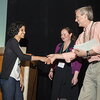
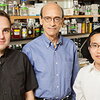
Amruta Bhate, a 3rd year biochemistry graduate student in the Kalsotra lab, has won the best poster award at the 2015 Annual RNA Society Meeting for her discovery of a previously unexplored function for alternative splicing in liver maturation.
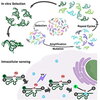
Sodium ions (Na+) play diverse and important roles in biological processes, and yet few sensors with high sensitivity and selectivity for Na+ over other competing metal ions have been reported. In this study, the authors reported the first highly selective, sensitive, and efficient Na+-specific...
The Department of Biochemistry congratulates first-year graduate student Mara Livezey on winning a prestigious National Science Foundation Graduate Research Fellowship. The fellowship provides three years of pre-doctoral funding, which will support her work in Professor David Shapiro’s lab.
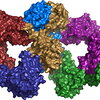
Biochemistry graduate student Pei Wang and Associate Professor Raven Huang have discovered a new bacterial RNA repair complex. The structure of the 270-kDa RNA repair complex revealed that it is built like a shopping mall, and RNA repair can be achieved having the damaged RNA visiting four active...
Biochemistry researchers in Dr. David Shapiro's lab, and a study team including researchers from the department of food science and human nutrition, the department of molecular and integrative physiology, the College of Medicine and the Cancer Center, have developed a new drug that kills estrogen...
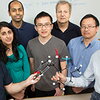
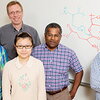
From left, University of Illinois graduate research assistant Manuel A. Ortega, chemistry professor Wilfred van der Donk, graduate student Yue Hao, biochemistry professor Satish Nair, and postdoctoral researcher Mark Walker solved a decades-old mystery into how a broad class of natural antibiotics...
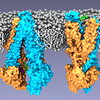
Large-scale simulations will develop a greater understanding of cellular membrane transporters, which could allow drug developers to design more targeted drugs for major pathophysiological conditions such as psychological disorders, cancer, and multi-drug resistance.
"Lowell created an environment where creativity was fostered, scientific standards were high and doing science was fun. He left his mark on the department that remains to this day."
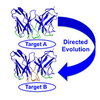
Graduate student Sheena Smith and Professor David Kranz of the Department of Biochemistry have developed an approach to discover T cell receptors that could be therapeutically useful against different cancers. In collaboration with graduate students Yuhang Wang and Javier Baylor and Professor Emad...
Biochemistry professor David Shapiro, M.D.-Ph.D student Neal Andruska, graduate student Xiaobin Zheng and their colleagues discovered a new mechanism by which estrogen contributes to the pathology of breast cancer. The findings are published in the journal Oncogene.