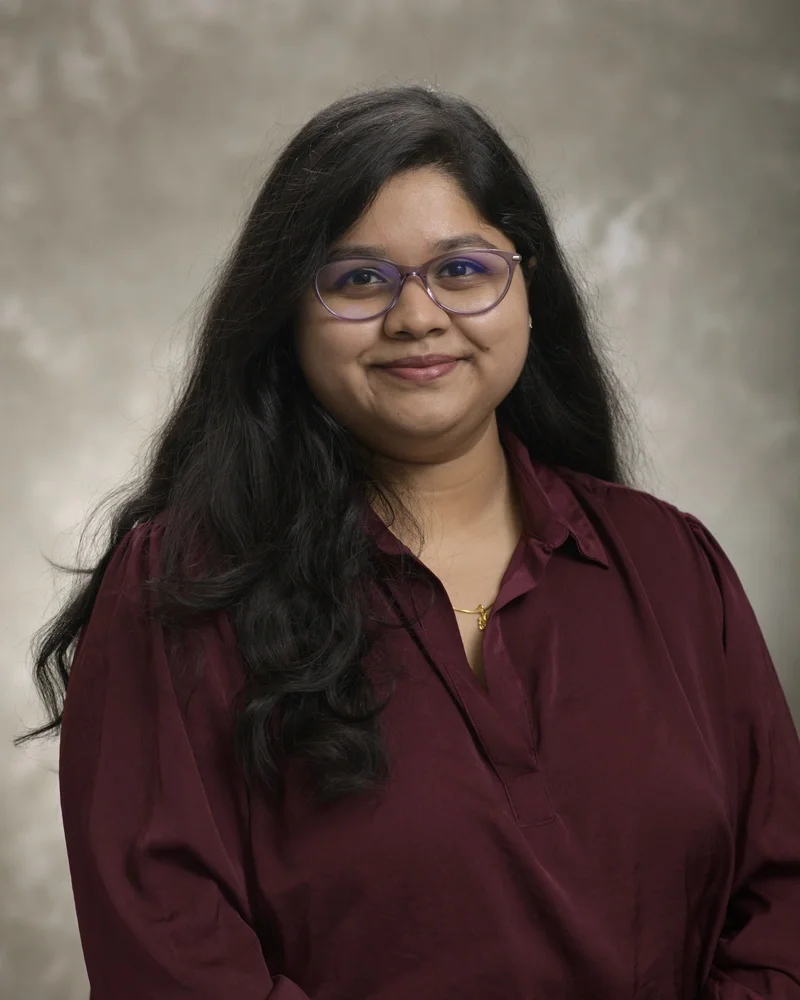
When Tanya Pattnaik was just starting her PhD at the University of Illinois, a professor told her no matter what kind of experiments she designed, techniques she learned, or papers she wrote, two things were certain.
Number one: she’d gain the research and scientific expertise required to and produce a dissertation. Number two: she would be a different person coming out than she was coming in.
Pattnaik proved that professor correct this past semester. In April, she and her team earned first place at the FACES Consulting competition. One month later, she was awarded the Graduate College’s Dissertation Completion Fellowship, which supports doctoral students as they finalize their dissertations, and the School of Molecular & Cellular Biology presented her with the Julie and David Mead Graduate Student Fellowship for excellence as a PhD student.
“Beyond the financial support, receiving this recognition is deeply encouraging,” Pattnaik said of the Mead Fellowship. “It affirms that the work we do as graduate students has value and impact, and it motivates me to continue striving for excellence in my research and professional development.”
For Pattnaik, outcome number one of her PhD, the research, comes naturally. From an early age, she was adept at math and science — a side effect of her upbringing with a doctor and an engineer for parents. As for biology, a high school teacher’s lessons piqued her interest. “He taught beyond the textbook,” she said. “He made us appreciate the vastness and the technical depth of the content that he was teaching, what it meant in the scale of the universe.”
Pattnaik grew up an hour and a half drive from the Bay of Bengal in Bhubaneswar, Odisha, India. She earned her undergraduate and master’s degrees there, at the National Institute of Science Education and Research.
“I come from a place and time where some people were disappointed because I was a girl child instead of a boy child,” she said. “My parents never let that get to me. They wanted me to make something of myself and stand on my own two feet, and they made sure I always had female role models that I could look up to.”
As a young person, Pattnaik was shy and terrified of public speaking, often fumbling her words in speeches and presentations. Today, however, presenting her research is just as intuitive to Pattnaik as conducting it.
“I now find public speaking genuinely enjoyable,” she said. “This transformation was the result of repeated exposure and practice.” Pattnaik has presented at two international conferences, two departmental retreats, and she regularly presents at lab meetings and in her work as a project manager at FACES Consulting.
Described as the first consulting group founded by and for international students at Illinois, this registered student organization holds an annual case competition where its members present their innovative solutions to real clients’ problems.
Since joining FACES nearly a year ago, Pattnaik has consulted for a medical device company, helping their product break into the European Union market. Her first-place project from this year’s competition, “Renewable Blue” offered sustainability solutions to a major international brand.
Pattnaik credits her team’s victory largely to their tenacious presentational acumen, which she says has directly translated to practicing and presenting her science.
“Consultants take information, they make hypotheses, they test them, and then they figure out solutions, which is identical to how a research project works,” Pattnaik said. “As I have grown through my PhD program, so have my communication skills and style. I don’t even have to think about it anymore. I know my research inside out and I know I’m the best person to present it.”
Pattnaik is now in her fourth year as a PhD candidate in the Department of Molecular & Integrative Physiology. Upon completing her rotations, she joined Dr. Patrick Sweeney’s lab after learning about their shared interests in neuroscience, reproductive processes, and the relationship between the two.
“At some point in my career, I knew I wanted to work in women’s health,” Pattnaik said. “But I didn’t know what topic exactly because everything is so understudied. But when Dr. Sweeney and I were discussing projects, he brought up that he was considering doing something with pregnancy and lactation. I really jumped at that chance.”
Pattnaik and her fellow PhD student Kerem Çatalbaş discovered that pregnancy and lactation fundamentally alter the brain’s feeding circuitry. Their initial findings, which demonstrated how AgRP neurons regulate hyperphagia during lactation, were published in Molecular Metabolism in 2024.
Building on this work, Pattnaik focused on the brain’s dopamine circuitry and how it is altered during pregnancy and lactation. She found that pregnant and lactating mice undergo a fundamental shift in how they perceive food rewards. Specifically, these animals exhibit an enhanced dopamine response to food, which drives increased food-seeking behavior and helps meet the substantial energetic demands of supporting their offspring.
This research has been reported in two parts: the first was published in Molecular Metabolism in 2026, and the second is currently in press at Cell Reports.
“Tanya and I were very interested in this question, but from different perspectives,” Çatalbaş recalled. “She was mostly looking for why mice were so motivated to seek food, eat more, take care of their pups, those kinds of things. But we were looking at the same focal point. It’s so fun whenever you have that colleague next to you that’s not doing the same thing as you but is complementary.”
As complementary as their data are, Çatalbaş’ and Pattnaik’s personalities have become more so. “I’ve never had to figure out anything alone,” she said, “If I ever have an issue in the lab, I have access to a great support system, made up of brilliant undergraduate students, incredibly helpful graduate students, and a highly enthusiastic and supportive PI.”
They frequently offer each other guidance on new techniques and expertise in topics they’re not as familiar with. Even in the middle of the night when Çatalbaş sends voice texts asking for research about specific brain regions, Pattnaik usually texts back with multiple references a few minutes later.
“We’re very blessed with having a great lab — research supervisor as well as lab mates. It really helps us with our science as well as becoming the best versions of ourselves,” Pattnaik said, fulfilling a prediction four years in the making.