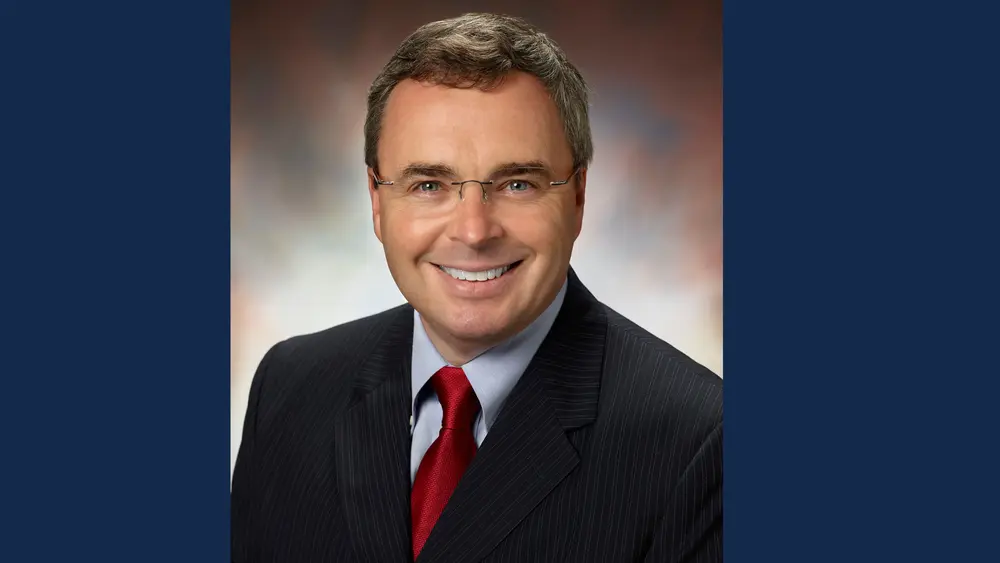
The School of Molecular & Cellular Biology is pleased to announce Dr. Guy Padbury as the guest speaker for its May 2026 convocation.
On a recent visit to campus, he spoke about his path to Illinois, his work as a translational scientist, and what inspires him. Dr. Padbury’s career has been influenced by a wide range of experiences, beginning with his upbringing in a working-class family and his journey as an immigrant from England. After earning a bachelor’s degree in chemistry from Butler University in 1981, he went on to receive his PhD in Biochemistry from the University of Illinois in 1988, becoming the first member of his family to earn a doctoral degree.
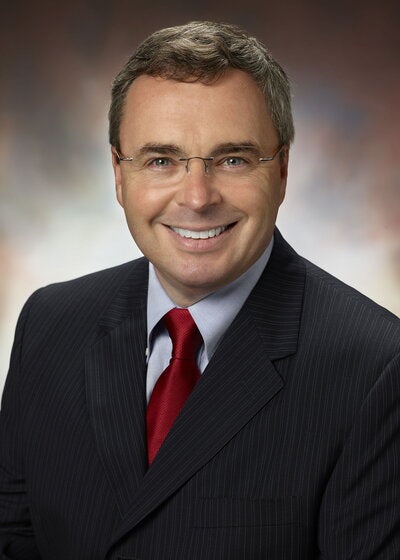
Over the course of his career, Dr. Padbury has taken on a variety of roles, continually embracing new challenges in drug development and production. Trained initially as a mechanistic enzymologist, he now works at Pfizer as a translational scientist, helping bridge the gap between disciplines by coordinating efforts among chemists, protein scientists, toxicologists, and pharmacologists to move drug candidates from discovery to production.
Coming from a working-class background, how did your parents view education and how did that affect you growing up?
My parents immigrated to the United States to give my sister and me better educational opportunities—opportunities we wouldn’t have had if we had stayed where we previously lived. Because of that, education was always a priority in our household. The goal was simply to earn a college degree and fulfill the American dream. Graduate school, and especially a PhD, wasn’t really on the horizon for me. But one of my mentors [at Dow Pharmaceuticals, where I worked for two years after earning my bachelor’s degree] strongly encouraged me to pursue it, and that ultimately led me to the University of Illinois, where I earned both my master’s degree and my PhD in biochemistry.
What motivated you to pursue biochemistry, and how did that interest lead you to your current work?
I would say being open-minded to opportunity and stepping into areas that were not exactly familiar to me is what led to my current work. [At Butler], I started off as a pharmacy major and did not like it. So, I ended up as a chemistry major where I later got a summer internship [at Dow] and that led me into an industrial career. … I went from analytical chemistry to immunoanalytical chemistry, which opened the door for biochemistry. What I liked about going from analytical chemistry to biochemisty was the unpredictability of it, what human physiology brings to the equation.
I like to put myself in situations where I can be intimidated, so I can prove to myself I can do that and learn from others. Fear is a great motivator for me. Putting yourself in uncomfortableness invigorates your learning juices.
What did you focus on during your PhD?
My mentor was [biochemistry professor and Swanlund Endowed Chair Emeritus] Stephen Sligar, and my work is best described as mechanistic enzymology. The area of enzymology was studying liver enzyme systems responsible for detoxification and increasing water solubility of compounds. Although I didn’t work directly on that specific enzyme system, my training focused on the fundamentals of drug metabolism. I was also a protein scientist.
When I left the university, I entered a drug metabolism group because I had a strong background in drug metabolism and protein science. At the time, the industry had mostly been in small molecules. They were on the threshold or on the welcome mat to the threshold of what are now biologic drugs.
I read that your father was diagnosed with Type 2 Diabetes. Did that experience influence the focus of your work and if so, how?
Yes, profoundly. In the beginning, I would go into work because I was intrigued by the science and the mission of making drugs to benefit patients. But the patient was abstract. In the second-third of my career, I worked on an anti-diabetic drug. Around that time, my dad was diagnosed as a Type 2 diabetic, and he went on this drug.
What that did for me is it put a face to the patient. And it made me realize that ... it's your loved one. It’s your mom. It's your dad. It's your sister. Ever since then there is a sense of urgency that many of the things that I worked on are not only about improving somebody's quality of life, but also the longevity. And then you also start to appreciate the amplified benefit for the loved ones around them. That makes it pretty easy to come into work, especially as, over the years, I've migrated more into the oncology space.
What was a challenge you faced in your career, and what did it teach you?
At a certain point you transition from individual researcher to a team. The hardest, but best, feedback I ever received came from a team member. She told me I needed to stop trying to make them all ‘little guys’ and to give them their space. Instead of teaching everyone how to do things the way I would do it, I should focus on what we want to achieve. That advice was a turning point. I learned to step back, focus on what we wanted to achieve together, and give people the space to develop their own approaches. In doing so, I ended up learning far more, because they became mentors to me.
More PhD students are considering pursuing careers in industry vs. academia. Can you share what’s been rewarding about your career in industry?
We all have different motivations and different interests, and so I don't know that it’s one versus the other. You’ve got to be true to yourself. I have peers in academia and industry and we’re both jealous of what the other has.
In industry, you have access to greater resources and spend far less time writing grants. But the work is driven by specific deliverables that aren’t always at your own direction. The trade-off is clear: while you gain resources and support, you give up some autonomy and the freedom to pursue the next question purely out of scientific curiosity. … But the trade-off [in academia] is, particularly now in the current environment, you have to follow what the granting agencies are interested in. On the other hand, I might have the resource flexibility, but my bandwidth is a little narrower. And [in industry you] don't necessarily get that turnover of talent that brings in diversity of thinking and challenges. You get a lot of experienced individuals who teach you.
Both can be rewarding. The wonderful thing is that going into science is … every year I am doing something different because technology evolves, science evolves. What I did last year is not what I am spending most of my time doing this year. You’re constantly reinventing yourself and learning to challenge yourself and that is a very rewarding place to be intellectually.
Could you talk about how the research and development landscape has evolved over the course of your career?
When I first started, we would use [High Performance Liquid Chromatography] systems. That went away with mass spectrophotometers. It was transformative. We have gone from spending most of the time generating data to interpreting data because the cycle time of experiments is accelerated.
The big thing is how is AI going to come into our industry? I use the term augmented intelligence instead of artificial intelligence. You still need critical thinking as a scientist. As a scientist in today’s world, your value is not primarily in data generation, it’s in data interpretation, hypothesis formation, and experimental design.
What are you currently working on?
Oncology. We have several drugs known as antibody–drug conjugates. These therapies have three main parts: an antibody that directs the treatment to a specific target on the cancer cell, a linker, and a “warhead” attached to the linker that is designed to destroy the target cell. This structure allows the drug to target the tumor more specifically, helping reduce adverse effects while delivering a high concentration of the lethal payload directly to the cancer cells, which improves efficacy.
What gives you optimism about the future of science?
I’m confident that science will win. We're in a moment in our society where we have certain corners that are diminishing the emphasis and perhaps not acknowledging the importance of science, but science will win. I’m confident this next generation of scientists will be scientific warriors—they’re going to have to push through this moment in time. The newly-minted master’s and PhD students we hire today bring remarkable breadth and talent compared to when I first started. We have incredibly bright, gifted scientists coming up behind us.