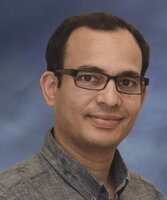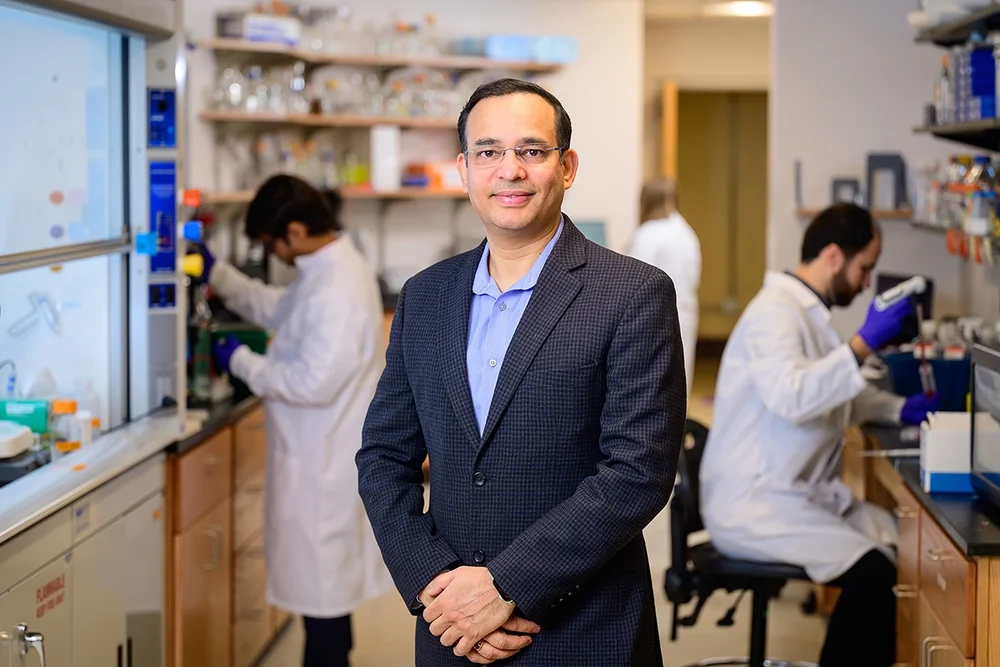
The School of Molecular and Cellular Biology is honored to announce that Auinash Kalsotra has been named the Phillip A. Sharp Professor in Biochemistry.
Dr. Kalsotra is one of the world’s pre-eminent RNA researchers and has also been recognized as one of the University of Illinois’ leading mentors. His lab focuses on how RNA transcription impacts tissue growth, what happens when those mechanisms go awry, and how understanding these relationships can lead to novel therapies to address various diseases.
“Carrying the Phil Sharp Professorship is an absolute honor and a charge to push the frontiers of RNA biology,” Kalsotra said. “Dr. Sharp’s discovery of RNA splicing transformed our view of gene regulation, and that vision continues to guide our work.”
Auinash “Nash” Kalsotra joined the Illinois Department of Biochemistry faculty in 2012 after completing postdoctoral research at the Baylor College of Medicine and receiving his PhD from the University of Texas, Houston. Since then, Kalsotra and members of his lab have continued to be at the forefront of RNA research. He has published over 75 peer-reviewed articles and has received funding from the National Institutes of Health, the Department of Defense, the Roy J. Carver Trust, and the American Heart Association.
“Our lab has shown that specific splice variants can actually tip the balance between healthy physiology and disease,” Kalsotra said. “More recently we discovered that disrupted splicing impairs the liver’s ability to regenerate in alcoholic liver disease, directly linking RNA processing to failed tissue repair.”
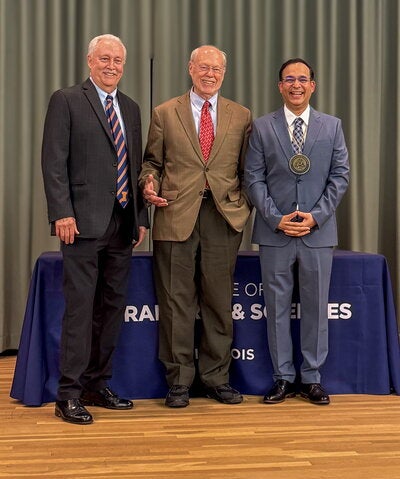
The endowed professorship is made possible by the generous support of Dr. Phillip Sharp, Institute Professor and Professor of Biology Emeritus at the Massachusetts Institute of Technology, and Ann Sharp. Dr. Sharp earned his PhD in Chemistry from Illinois in 1969 and completed his postdoctoral work at the California Institute of Technology. In 1993, he won the Nobel Prize in Physiology or Medicine with Richard J. Roberts for the discovery of split genes. He is a co-founder of Biogen, one of the world’s first biotechnology companies.
In addition to serving as director of MIT’s cancer center and head of its department of biology, Sharp continued to uncover new insights about gene expression, non-coding RNAs, and RNA splicing. In fact, an upcoming study from the Kalsotra lab builds directly on Sharp’s 2015 discovery of “detained introns.” Detained introns are deliberately retained within specific RNAs to keep them in the nucleus and prevent their translation into proteins.
In 2025, Kalsotra received the School of MCB Trainee Mentoring Excellence Award in recognition of his outstanding mentorship of graduate students and postdoctoral students.
“What makes Illinois and MCB special for me is the students. They are sharp, curious, and not afraid to take on hard problems. Just as important is the way people here naturally work across boundaries, whether it is engineers, biologists, or physicians sitting down and really thinking together. That mix of talent, trust, and openness makes Illinois a place where ideas don’t just stay ideas for too long,” he added.
In addition to his appointment in Biochemistry, Kalsotra holds appointments in the Division of Nutritional Sciences, the Cancer Center, and the Carl R. Woese Institute for Genomic Biology. He is a Beckman Fellow at the Center for Advanced Study and a Chan Zuckerburg Biohub investigator.
The investiture took place on April 22, 2026, at the Beckman Institute on the University of Illinois Urbana-Champaign campus.