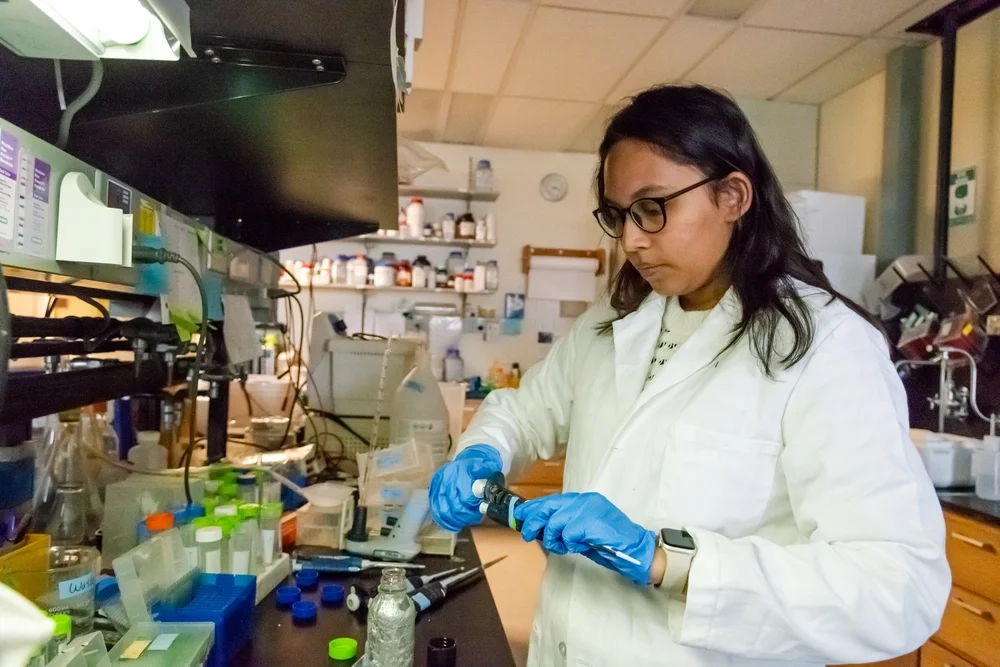
The School of Molecular & Cellular Biology is pleased to announce that Reean Abdullah, a PhD candidate in the Jie Chen lab, has been awarded the inaugural Irene M. Jones Graduate Fellowship.
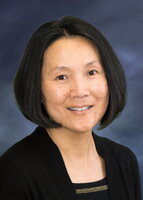
Established as an approximately $25,000 award, the fellowship was established by Dr. Irene Jones (PhD, ’72, Cell and Molecular Biology) who spent the majority of her career as a biologist at the Lawrence Livermore National Laboratory.
Abdullah, a member of the Dr. Jie Chen lab, studies the non-canonical functions of amino acyl tRNA synthetases and their link to cancer biology. Her debut paper as a first author, “Threonyl-tRNA synthetase activates STAT3 by a nontranslational mechanism” was published in the Journal of Biological Chemistry in February 2026. The research received an Editors’ Pick commendation from the journal’s staff and was covered by the School of MCB in April.
Abdullah, along with fellow PhD candidate Pallob Barai, found that the aminoacyl-tRNA synthetase enzyme TARS-1 activates STAT3 (an oncogene present in multiple cancer types), thus explaining why some cancers can be so aggressive.
“I had tried many times, and before me other people had tried to prove the interaction between TARS and STAT3” Abdullah said. “It took me months of asking ‘Are these two things physically interacting?’”
Jones has similar recollections of her own PhD experience when she studied the relationship between the Tobacco Necrosis Virus and its Satellite virus. “That work was all a combination of brute force and a lot of tedium. That’s why they call it re-search. You search over and over again for what you’re trying to find.”
As a PhD student at Illinois, Irene Jones worked in Dr. Eli Reichmann’s lab in the Department of Botany, now the Department of Plant Biology. After a brief stint on the faculty at Grinnell College where she met her husband Paul, Jones moved to Livermore, California. At Livermore, Jones studied the biological effects of radiation and genotoxic chemicals, especially concerning the hprt gene which helps recycle unusable DNA and RNA. Her most impactful project involved applying her research to inform radiation safety practices based on data collected from crews cleaning up the aftermath of the Chernobyl disaster.
After she receives her PhD, Abduallah hopes to pursue a career focused on developing novel cancer therapeutics.
“Receiving this award in the third year of my PhD is incredibly encouraging and motivates me to continue challenging myself as a scientist,” Abdullah said. “Together with the invaluable mentorship of my advisor, Dr. Jie Chen, this fellowship will help me build the skills needed to investigate the molecular mechanisms underlying signaling in both normal biology and disease.”