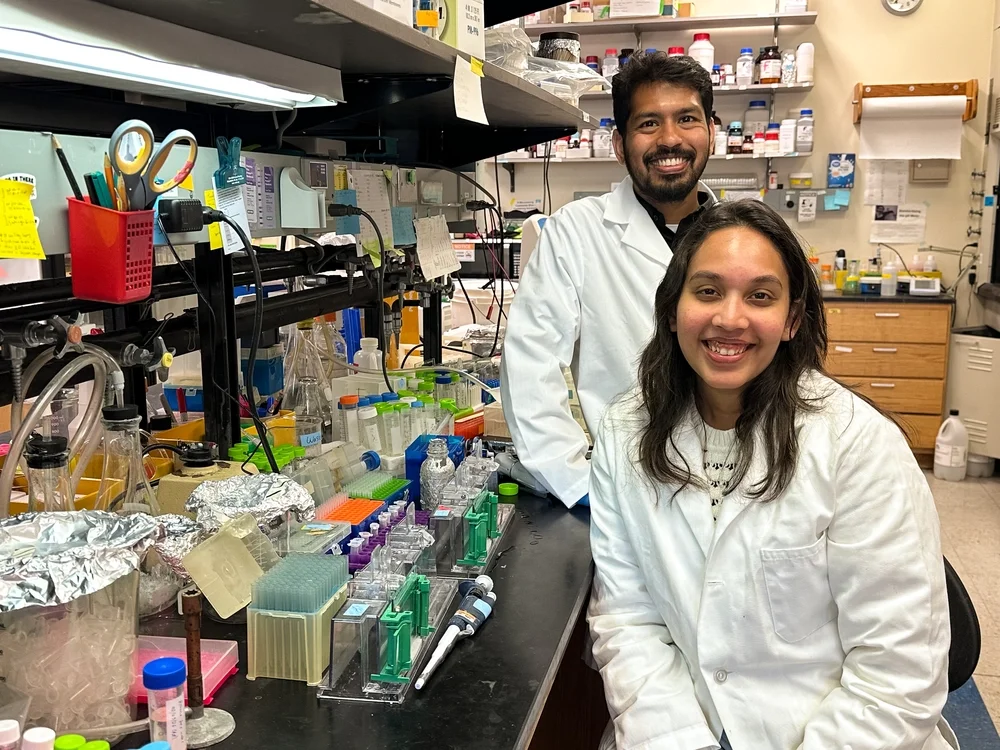
One day, on assignment researching non-canonical functions of aminoacyl-tRNA synthetases — housekeeping enzymes essential for protein synthesis — Pallob Barai noticed an intriguing pattern.
“A particular AARS enzyme, TARS1, was found to be correlated with poor patient survival in different cancers, particularly non-small cell lung cancer,” recalled Barai, a PhD student in Cell and Developmental Biology.
To see if this correlation had a causal basis, he and PhD student Reean Abdullah, both students in the lab of Professor Jie Chen, designed a series of experiments that would deplete endogenous TARS1 and then reintroduce TARS1 or its mutants in cells.
In doing so, the team revealed how TARS1, by binding to a Janus kinase (JAK) and STAT3 — a well-known oncogene found in multiple types of cancers — activates STAT3, thus proving the TARS1-cancer correlation as a causal relationship and unveiling a mechanism that causes certain cancers to become so aggressive.

Their findings, “Threonyl-tRNA synthetase activates STAT3 by a nontranslational mechanism,” were published in the Journal of Biological Chemistry. The article earned an Editors’ Pick commendation from the journal’s staff.
Dr. Chen’s lab investigates novel signaling mechanisms underlying fundamental cellular and physiological processes in mammals. In this case, the paper’s “nontranslational mechanism” contains three distinct components.
TARS1 acts as a “scaffold,” providing the mechanism’s structural foundation by bringing two signaling components (STAT3 and JAK) into closer proximity, according to Barai.
“TARS1 has multiple domains, and we dissected which of its domains interact with which proteins,” he said. The team found one domain binds JAK, and a different domain binds STAT3. “It’s like TARS1 has one hand holding JAK with the other hand holding STAT3.”
If TARS1 is the cancer proliferation mechanism’s structure, then JAK is its engine. As a protein tyrosine kinase, JAK can phosphorylate STAT3, which in turn moves into the nucleus to regulate gene expression.
“As a transcription factor, [STAT3] activates the expression of genes which lead to cell proliferation, survival, and differentiation,” Abdullah said. “And when it’s constitutively activated, then it starts transcribing genes that are relevant in the hyper-growth of cells. When that happens, you make cancer.”
To prove that TARS1 was the missing piece in JAK activation of STAT3 in cancer, Barai and Abdullah depleted it from cancer cells. When the TARS1 protein level was lowered, drastically smaller amounts of STAT3 were phosphorylated by JAK and cancer cell proliferation was curtailed. In collaboration with Dr. Erik Nelson’s lab, the research team observed reduced tumor formation in a mouse xenograft model when TARS1 protein levels were diminished.
However, researchers did not know what caused TARS1 to be such an effective broker between JAK and STAT3. Was it simply due to TARS1’s ability to hold JAK and STAT3 together, or was protein synthesis still involved?
To find out, Barai and Abdullah overexpressed a mutant version of TARS1 that did not have a protein synthesis function.
“We saw that phenotype to be true: when we reintroduced [catalytically inactive] TARS1, it ‘rescued’ the cell proliferation phenotype,” Barai said. “Meaning that for this mechanism to work, TARS1 does not need translational activity.”
Uncovering TARS1’s role in the JAK-STAT3 pathway carries implications beyond discovering a novel mechanism that potentially propagates non-small cell lung cancer.
“TARS1 has multiple non-catalytic domains that are utilized for non-translational functions,” Abdullah said. “But the interesting thing here was that TARS1 was doing the inverse — utilizing catalytic domains for non-catalytic purposes.”
This TARS1 mechanism may be more widespread than what the Chen lab reported here. TARS1 overexpression is found in many types of human cancers. “Seeing if overexpressed TARS1 can activate oncogenic STAT3 in a variety of cancers — that’s the immediate future direction,” Abdullah said.