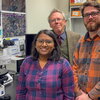
Researchers from the University of Illinois School of Molecular & Cellular Biology are examining the influence on nuclear pathways from the molecular chaperone, TCP-1 Ring complex (TRiC).Cell and developmental biology professor Brian Freeman’s lab focuses on chaperonins like TRiC, which help...
In a new publication, University of Illinois scientists have begun to unravel how nuclear type 1 myosin influences the cell nucleus. Recently, they have found that the protein was essential for cell division and plays a critical role in shaping the activities of nuclear organization. The...
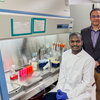
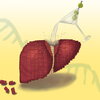
University of Illinois researchers have made a breakthrough discovery in the fight against liver cancer. Collaborators Lin-Feng Chen, Susan A. Martinis, and graduate...
One day, on assignment researching non-canonical functions of aminoacyl-tRNA synthetases — housekeeping enzymes essential for protein synthesis — Pallob Barai noticed an intriguing pattern.“A particular AARS enzyme, TARS1, was found to be correlated with poor patient survival in different cancers,...
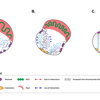
New research from the K.V. Prasanth lab, in collaboration with scientists across the University of Illinois and other institutions, has revealed that gene positioning near nuclear speckles — key nuclear domains that promote gene expression — along with the mechanistic functions of the non-coding...
The task: calculate every movement of every human in New York City and, based on those data, create a picture-perfect map of the city's skyline. Seem impossible?And yet, this resembles what two School of Molecular & Cellular Biology scientists recently accomplished while investigating E....
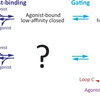
In new research, University of Illinois scientists have challenged previously held scientific ideas about loop-C’s functional role within ligand-gated ion channels, deepening biologists’ understanding of the complex neurotransmission process.Their study,...
Imagine a treadmill. As it moves, the track is constantly receding but is replenished at an equal rate on the opposite end. The result is a machine in perpetual motion, but which has its length stay exactly the same. For decades, biologists have regarded “treadmilling” as the standard...
Myotonic Dystrophy type 1, also known as DM1, is a genetic disorder that causes progressive muscle weakness, delayed muscle relaxation, and cardiac issues that can often be life-threatening. It is the most common cause of adult-onset muscular dystrophy and affects roughly 1 in 2,000 individuals...
Excessive alcohol consumption can disrupt the liver’s unique regenerative abilities by trapping cells in limbo between their functional and regenerative states, even after a patient stops drinking, researchers at University of Illinois Urbana-Champaign and collaborators at Duke University and the...