Myotonic Dystrophy type 1, also known as DM1, is a genetic disorder that causes progressive muscle weakness, delayed muscle relaxation, and cardiac issues that can often be life-threatening. It is the most common cause of adult-onset muscular dystrophy and affects roughly 1 in 2,000 individuals every year. By uncovering the cellular mechanisms behind DM1, new discoveries by University of Illinois researchers could pave the way for newer, more effective treatments for patients with cardiac symptoms.
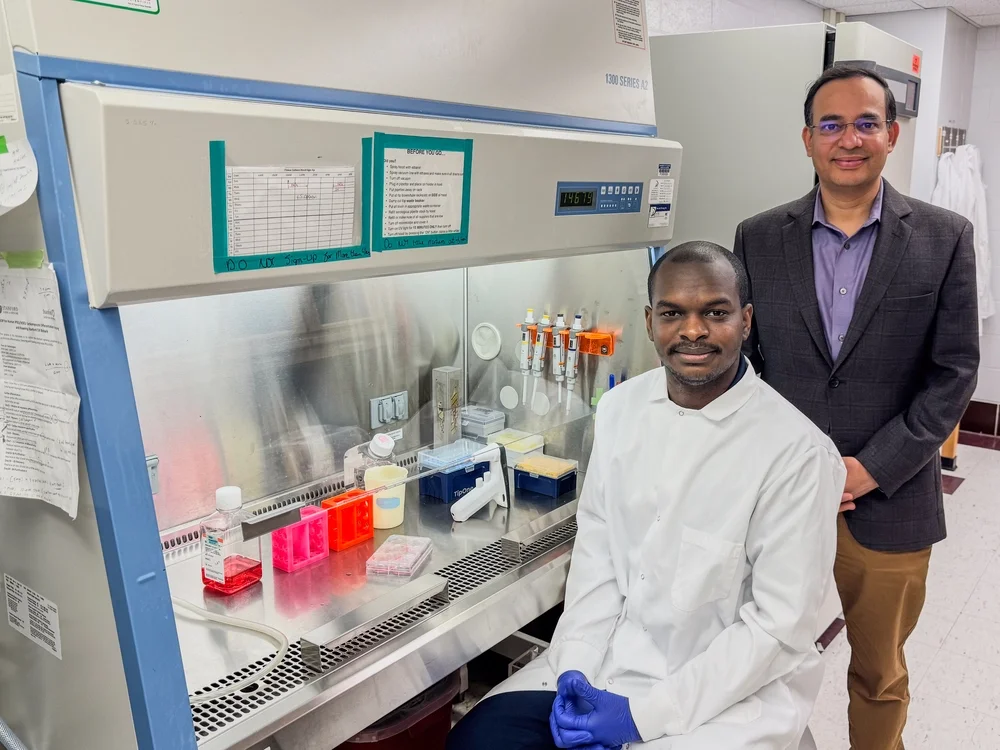
The study, led by University of Illinois Biochemistry professor Auinash Kalsotra and PhD candidate Oluwafolajimi Adesanya, was published in the American Heart Association journal, Circulation: Genomic and Precision Medicine.
“These findings are very exciting and potentially ground-breaking,” Kalsotra said. “We used cutting-edge methods to measure oxidative respiration and energy, or ATP, generation in mitochondria from normal and diseased mouse hearts.”
Mitochondria, the “powerhouses of the cell,” act like engines, taking in fuel and converting it into expendable ATP for the body. Impairing this process can spell dire consequences for heart function.
“What we found was that mouse hearts with DM1 had mitochondria that were smaller, more clumped together, and significantly more fragmented than normal,” said Adesanya, the study’s first author. “We believe that might be the key that explains why diseased mitochondria produce lower levels of ATP.”
Scientists widely recognize that gene mutations will translate into proteins exhibiting a loss or gain of function, contributing to a variety of health disorders. However, for DM1 it is not so simple.
“What causes the disease is not at the protein level but at the RNA level,” Kalsotra said. “DM1 is a disease characterized by widespread mis-splicing of RNA transcripts.”

In a cell, an RNA molecule can be visualized as a sentence put together by a combination of words and phrases. In a cell, these words and phrases are called “introns” and “exons.” RNA mis-splicing involves joining the words and phrases together in a way that makes the sentence lose its initial meaning or mean something else entirely.
Adesanya and Kalsotra hypothesized that when cellular energy production falters because of incorrect RNA splicing, the mitochondria start acting like those they observed in the diseased hearts.
Chasing this suspicion, they found that DM1 induces the mis-splicing of two important transcripts — MFF and DNM1L. These two RNA transcripts dictate how mitochondria fragment, explaining why DM1-hearts had mitochondria that were more clumped together.
“This was a crucial discovery for us,” Adesanya said. “We finally had the molecular link between the diseased mitochondria we’d observed, and certain mis-splicing events known to happen in DM1.” To confirm their findings, the researchers manually altered the splicing of the MFF and DNM1L RNA transcripts in cultured cells and observed the mitochondrial defects in real time.
“We’re really excited about these findings, Kalsotra said. “They open up new directions for further research and provide previously unknown answers to important questions surrounding DM1.”
Adesanya and Kalsotra have now set their sights on alleviating DM1 symptoms for patients by investigating the potential of reversing RNA mis-splicing. “We hope our results will serve as a platform to describe new treatment strategies for DM1 patients with cardiac symptoms,” Kalsotra said. “We look forward to communicating these additional findings in the near future.”