Imagine a treadmill.
As it moves, the track is constantly receding but is replenished at an equal rate on the opposite end. The result is a machine in perpetual motion, but which has its length stay exactly the same.
For decades, biologists have regarded “treadmilling” as the standard behavior of actin filaments in cells. That is until three Illinois scientists revealed a more detailed picture — and broadened science’s perception — of how the cell’s cytoskeleton operates. Their findings were published in the Proceedings of the National Academy of Sciences.
In their steady state, actin filaments treadmill with microscopic, chevron-shaped “monomers” that tack onto the back of a single-file line. Resembling a “lesser-than” symbol, “<”, scientists have affectionately labeled the ends of each monomer the “barbed end” and the “pointed end.” As soon as a new monomer is secured into the barbed end, the front monomer then falls back into the cytoplasm. Throughout, just like a treadmill, the filament’s length stays consistent.
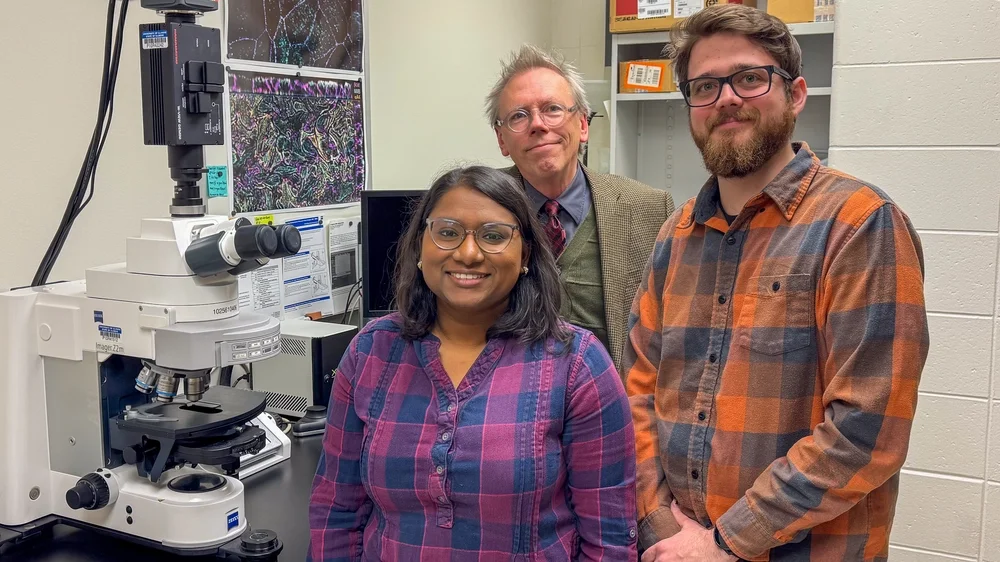
When Madhura Duttagupta (PhD ’25, Cell and Developmental Biology) designed an experiment studying actin filament behavior, her control group — the data that’re supposed to be predictable and unsurprising — depended on actin filament monomers treadmilling away as usual. Instead, she saw a phenomenon that had been theorized, but which no human had ever seen before.
When the actin filaments were supposed to be in their steady state, monomers were instead joining and flying off by the dozens on the barbed end. The treadmill’s length kept changing, sometimes by five, 10, even up to 150 individual monomers.
“It wasn’t so much a eureka moment for me,” Duttagupta said. “I was very crestfallen because I thought my experiment was ruined. I took a little video of the microscope on my phone and emailed it to my advisor.”
“Yeah, and I was like, this is awesome!” said professor Bill Brieher, a Cell and Developmental Biology faculty member and Duttagupta’s PhD advisor. Brieher’s lab researches interactions between cells as well as the cell’s cytoskeleton, of which actin filaments are an integral part.
“I really do see actin as a skeleton,” Brieher said. “That skeleton provides the framework that dictates cell shape.” How long it takes that skeleton to form is a simple lesson in supply and demand. When a cell is born, its actin spurs into action in its “growth stage.” Monomers, available by the thousands in the cell’s cytoplasm, start attaching to each other, pointed end into barbed end.
How actin filaments form into a cell’s structure varies wildly. “Actin is the single most versatile protein in the body,” Duttagupta said. “Your skin cells, they have to stand tall and give you a barrier. That’s actin. But your blood cells have to squish into and move through capillaries. That’s also actin.”
Once the cell’s available space is occupied and fewer monomers are free to join the conga line, the actin filament enters its “steady state,” where — apparently restless — they start treadmilling. Paradoxically, the cell’s structure isn’t determined by rigidity, but by a continuous flux.
“I use this analogy in my class a lot,” Brieher said. “Consider two Chicago landmarks. The Hancock Building retains its shape because it has fixed, stable steel girders that hold it in position. Whereas for Buckingham Fountain, its form is being maintained by a constant energy input: the water shooting out of the nozzles. At any given moment, the water isn’t fixed but constantly recycling. That’s what the cell’s cytoskeleton is like.”
Because of Duttagupta’s finding, that motion now includes fluctuation, not just treadmilling. Why exactly monomers were haphazardly joining and falling off the barbed end was a mystery until Duttagupta took their energy state into account.
When monomers attach to the barbed end of the treadmill, they’re bound to adenosine triphosphate, or ATP — the cell’s energy currency. As the treadmill progresses, one phosphate group is consumed and the compound comes out the pointed end as, fittingly, adenosine diphosphate — ADP.
“ATP monomers really want to add and stay at the barbed end,” explained Andrew Riley, PhD student in Cell and Developmental Biology and contributing author of the research paper. “The ADP monomer, on the other hand, wants to fall off. Our idea for how nucleotides are involved is that, when we hit steady state and growth slows down, ATP is hydrolyzing and turning into ADP before new ATP monomers can add, creating an ADP barbed end. When that happens, the monomers start to fall off."
“In the classic treadmilling model,” Duttagupta added, “you would never expect to see anything other than ATP at that barbed end. That possibility wasn’t even acknowledged.”
The researchers pursued this hypothesis by injecting agents that neutralized the barbed end. The treatment worked, confirming their findings and, in the process, changing the scientific community’s fundamental understanding of the cell’s cytoskeleton.
“This is science at its best,” Duttagupta said. “Just because people are saying ‘This is how it works’ for 40 years, doesn’t mean that’s the whole picture. If we find something new that changes our previously held opinion — and we have — then we’re now one step closer to the truth.”