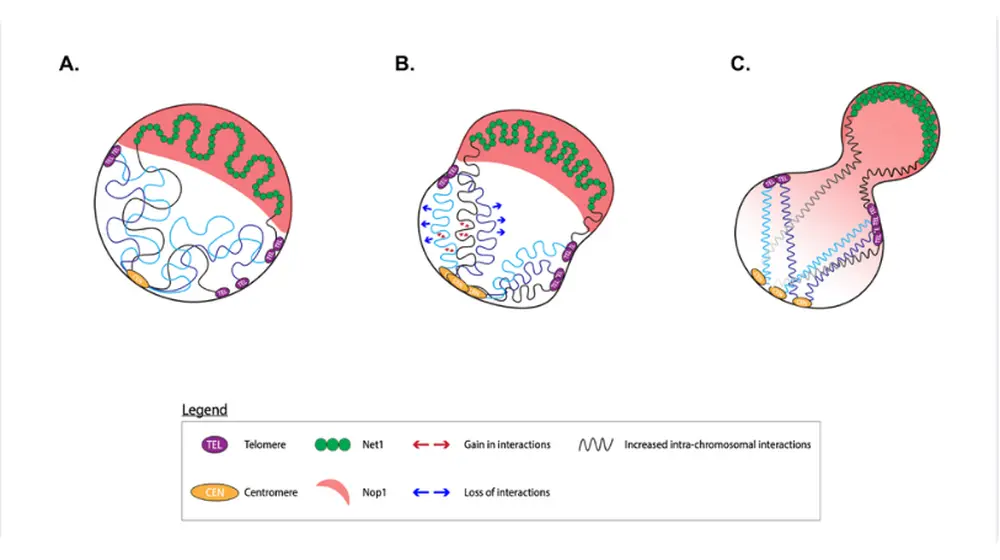
In a new publication, University of Illinois scientists have begun to unravel how nuclear type 1 myosin influences the cell nucleus. Recently, they have found that the protein was essential for cell division and plays a critical role in shaping the activities of nuclear organization. The researchers depleted nuclear type 1 myosin from the cell to assess its function, revealing drastic changes associated with its absence.
The study, led by Brian Freeman, Professor of Cell & Developmental Biology and Distinguished Professorial Scholar, and PhD student Audrey Peng, was published in the journal Genes and Development.
The nuclear type 1 myosin is a critical molecular protein that supports the 3D organization and maintenance of the genome structure, delivers chromosomes to set nuclear positions, and ensures nuclear architecture for proper cellular function. Therefore, when this protein is depleted, the 3D genome becomes disorganized, gene expression changes, and the nuclear envelope is deformed.
“I really wasn’t expecting much,” said Peng, the study's first author. “I remember I did my spot test...and I was like there’s a phenotype! We weren’t expecting it to be so drastic.”
Peng saw that removing the nuclear myosin, by using an anchor away approach, resulted in cell cycle arrest, meaning the cell stopped growing, revealing how vital myosins are in cell division.
Additionally, Peng wanted to investigate the genome organization after myosin was depleted and used a high-throughput method called Hi-C assay.
“The genes that are near each other stay near each other. Then you purify the pieces to figure out which gene was near each other in space,” Peng said.
Through this method, it was found that type 1 myosin depletion resulted in a gain in interactions nearby, but a loss in distal intrachromosomal contacts, meaning that type 1 myosin actively maintains the genome organization.
Despite Peng's findings, questions remain about how nuclear type 1 myosin mechanism, how its activity is coordinated within the cell, and how these discoveries may translate to human health.