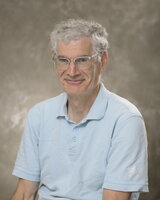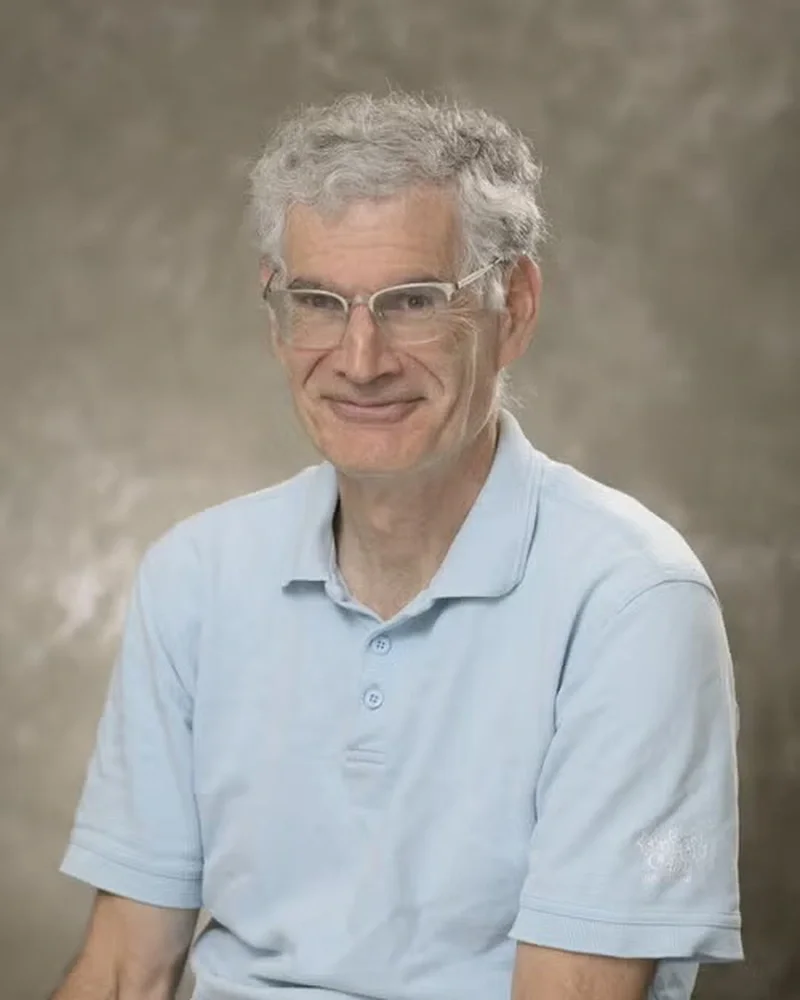
“What will it mean to be human at the turn of the 22nd century?” was a course Dr. Andrew Belmont, Professor of Cell & Developmental Biology, once volunteered to co-teach. The new course was proposed as part of a university-wide effort to bridge the sciences and the humanities. When Belmont was matched with a possible humanities faculty counterpart, it was immediately apparent just how far that bridge needed to span.
“The other Professor appeared to buy into the idea of the course. But then that person argued for emphasizing how science is subjective, as it has the biases of the researchers baked in as variables,” Belmont said. In response, Belmont asked how: “If a team of engineers and scientists were to aim and launch a rocket at the moon based on their understanding of gravity, the rocket is going to hit the moon or it’s going to miss,” he said. “You're going to get an objective result."
“You can make a discovery, independent of the person,” therefore, is an unusual thing to hear from someone whose career has been waymarked by as many discoveries, seminars across the globe, and recognitions as Andy Belmont’s.
His latest came during the Fall 2026 semester. In his 37th year at the University of Illinois, Dr. Belmont was named as an Edward William Gutgsell and Jane Marr Gutgsell Endowed Professor by the College of Liberal Arts & Sciences. Gutgsell awardees “exemplify excellence at the highest level, earning international recognition as leaders and innovators in their fields,” Provost John Coleman said in a statement.
The initial announcement came as a surprise to Belmont, who rarely seeks out such honors, instead prioritizing his research in the lab. Belmont was nominated by one of his successors as the Head of the Department of CDB, Dr. Supriya Prasanth.
“Dr. Andrew Belmont’s career exemplifies the very highest standards of scholarship, innovation, and leadership,” Prasanth said. “His sustained scientific excellence, together with his outstanding leadership as former Head of Cell & Developmental Biology and a leader of the NIH 4D Nucleome Initiative, makes him exceptionally deserving of this honor.”
As Prasanth described, Belmont has transformed science’s fundamental understanding of genome organization through pioneering discoveries in higher-order chromatin architecture, chromosome dynamics, and the role of nuclear organization in gene regulation, all while developing innovative techniques used in labs worldwide.
As a son, nephew, cousin, and brother of doctors, a career in medicine for the young Belmont seemed ordained. The challenge wasn’t so much which subject he would excel at, rather which one fit him best. His interest in biology as a high school freshman died from an overdose of memorization in AP Biology, leading him to a chemical engineering major as a freshman undergrad.
His interest in chemical engineering quickly waned after encountering an unstated requirement to approximate a key variable to solve a question on a final exam. They also took a field trip to a coal liquification plant in Northern New Jersey.
Halfway during his undergraduate at Princeton, the young Belmont settled on a physics major. “I enjoyed those classes because you usually didn’t have to get a number for an answer. You mostly just had to write the equation,” he said. When it came time to apply for graduate school, Belmont had two options: pursue his passion in physics or follow his family and apply to medical school.
“I couldn’t decide,” he said. “I went home for Thanksgiving, and my brother and first cousin were both in medical school at the time, and they asked me what I was going to do. When I said I was having trouble deciding, they spent the entire evening trying to convince me how awful medical school was and to do something else. Which is mostly how I ended up choosing medical school.”
Belmont earned his MD from Temple University in 1982 and his PhD a year later. He left his graduate studies with more questions than answers, both about his research and his health after receiving a diagnosis for a chronic disease. “I thought why subject myself to a very physically demanding residency and clinical training if what I really wanted to do was research?” he said.
Belmont hates memorization. He recalls his time in medical school as fraught with exams testing a student’s capacity for recalling information, not their ability to reason. To this day, Belmont still allows his students to reference a cheat sheet during exams — “a security blanket,” he calls it — and challenges them daily to think beyond their course’s content. He’s more concerned with teaching future scientists how to find solutions based on a logical chain of reasoning rather than memorizing a set of facts.
“On the first day in one of my classes, I would hold up the textbook and say, ‘You could learn everything in this book, but you could still do poorly on this exam,’” Belmont said. “If students just learn all these facts, they’ll still have to apply them and be able to come up with ideas for experiments, test certain hypotheses, and interpret experimental outcomes. When you just learn a lot of facts, it really doesn’t relate to how well you can use them to solve problems.”
And in his nearly forty-year-long career, Belmont has had to solve many problems. What he’s best known for is his work developing a method for identifying and tagging individual chromosomes and specific gene loci.
The human cell is one of the most compact, busiest places in the known universe, much like a major city. Belmont's research had shown that the cellular urban core was even more densely populated than previously thought. He reasoned that proteins which initiate and regulate the rate of DNA transcription to turn on specific genes would have to gain access to these layers of chromosomal compaction. They needed the key to the city.
Belmont's thinking was that, if these higher levels of chromosome compaction were indeed a barrier limiting silent gene expression, then transcription factors that bind to specific DNA sequences might have the ability to recruit proteins to help open up these condensed regions.
What would happen, then, if you tethered the transcription factor to a synthetic, engineered chromosome region that was unusually condensed? Would it really be able to part the crowd?
“There was an associate professor in chemistry, Jon Widom, who was also working in the chromatin field, and happened to be walking by to say hello,” Belmont said. “He entered the microscope room looking for me just seconds after I was getting my very first look at the result. A ~1 micron length engineered chromosome region had uncoiled into an extended fiber 20-30 times longer, filling a good part of the nucleus.”
His timing was remarkable. It was the one moment in my life where I literally got so excited that I jumped out of my chair.”
Perhaps another discovery that’d warrant some excitement would be Belmont inventing Tyramide signal amplification sequencing in 2018 — an original lab technique allowing scientists to accurately map how the cell’s genome is folded relative to important nuclear structures. Belmont’s original TSA-Seq paper has been cited nearly 450 times, both by labs worldwide and across the hall.
A recent publication from the School of MCB, “Polycomb-mediated 3D-genome organization controls replication timing,” used this method to great success. The study’s first author, Dr. Neha Chetlangia described TSA-Seq as “taking a central point in the nucleus and moving radially in different directions and seeing what DNA is present in each of those directions. You’re literally starting at the nucleus and walking along the DNA like a string and mapping from there.”
So, would TSA-Seq exist without Dr. Andrew Belmont? Would the discovery have occurred independent of the person?
Of course, science is objective in practice — either the rocket hits the moon or it doesn’t, you have a map of a cell or you don’t — but even Andrew Belmont as a young physics major would recognize the discovery equation as incomplete without a scientist. In this case, one of great persistence and inquisitiveness: enough to invent TSA-Sequencing, design how to tag individual chromosomes, and influence countless research papers, let alone receive an endowed professorship at the University of Illinois.
Not that Belmont will spend much time looking at his new title. “My wife’s the one who likes to sightsee,” he said. “I don’t like sightseeing. I like to actually do things.”