One of the largest and most comprehensive collaborations to understand the structure and dynamic function of membrane proteins was officially launched Tuesday with a 5-year, $22.5 million grant from the National Institute of General Medical Sciences. The international team of scientists funded by...
Assistant Professor of Biochemistry Lin-Feng Chen and colleagues have discovered a mechanism by which Helicobacter pylori, the only known cancer-causing bacterium, disables a tumor suppressor protein in host cells.
Of the approximately 100 cases that the Campus Committee on Promotion and Tenure reviewed this year, Associate Professor of Biochemistry Emad Tajkhorshid's dossier was one of just four recognized as exceptional in terms of quality of work and overall achievement.
A team of researchers led by Professor of Biochemistry John A. Gerlt has received a five-year, $33.9 million grant from the National Institutes of General Medical Sciences to study the functions of unknown enzymes.
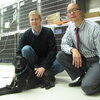
Biochemistry Student Quinn Peterson has been awarded a 2009-2010 American Chemical Society Predoctoral Fellowship. He is working on a cancer treatment, and doing clinical tests on dogs.
The School of Molecular and Cellular Biology Awards Ceremony was held Thursday, May 6, to recognize a number of our faculty, undergraduate students, and graduate students for excellence in teaching, academics, and research.
Want to know who is likely to win a Nobel prize? One consistent indicator is being invited to speak at the Ada Doisy Lecture Series. Remarkably, 25% of scientists who have accepted invitations to deliver the prestigious Ada Doisy Lecture in Biochemistry have gone on to win the Nobel Prize. This...
Professor of Biochemistry Stephen Sligar and colleagues have successfully recreated integrin activation in vitro, resolving long-standing uncertainties about the cellular mechanisms behind the process.
In a new study published in Cell, and rated "exceptional" by the Faculty of 1000 Biology, Professor of Biochemistry Jim Morrissey and colleagues have determined that polyphosphate, an inorganic polymer of phosphate, secreted by human platelets is an important link in thrombotic diseases and...