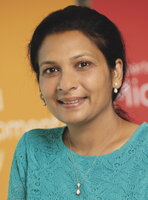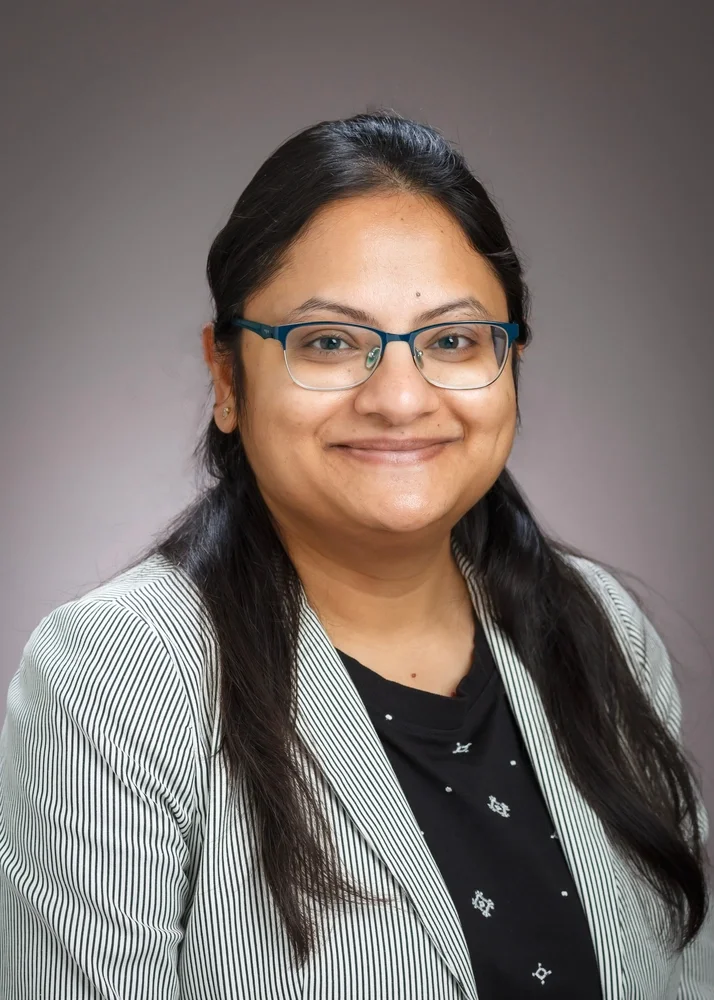
Before Dr. Surabhi Sonam could be called “doctor,” wife, mother, or research specialist at the Roy J. Carver Biotechnology Center, she was a member of the CDB Graduate Student Association.
In 2017, she and other members of the association had the idea of inviting alumni back to speak so current MCB students learn about the different career pathways taken by their predecessors. After presenting the idea to Professor Jie Chen, then head of the Department of Cell & Developmental Biology, the first CDB Career Development Seminar was launched.
Sonam served as the seminar series’ founding member and chair. The inaugural speaker was Dr. Marshall Brennan, who was the editor at Nature Chemistry at the time.
The most recent speaker? Dr. Surabhi Sonam.
“I never thought I’d be asked,” she said.
Sonam now joins the likes of entrepreneurs, scientists, and CEOs who have spoken at the seminars over the years. What set Sonam apart from every past speaker wasn’t just the short travel time — a three-block stroll up Goodwin Avenue. She’s instead an example that a PhD from the School of MCB can take you far, even if you’re close to home.
Sonam’s presentation, “Five Things No One Tells You About a Career in Genomics,” was “a wonderful opportunity for our graduate students to learn about and appreciate the many outstanding research and career opportunities available within the university,” said Supriya Prasanth, professor and current head of the Department of Cell & Developmental Biology.
As for the “Five Things,” they are:
- Biotech Core labs are diverse in discipline.
- Professional growth is key.
- Keep up with evolving technologies.
- Communications skills will take you far.
- Maintain a work-life balance.
Sonam’s talk was chock full of advice for young scientists. It is also her personal and educational journey writ small. When she was an undergrad at the University of Delhi, she wanted to excel in academics. However, feeling burnt out with coursework, she incorporated more leisure activities, such as concerts, into her life as a master’s degree student — a time that Sonam says stressed the importance of her talk’s fifth point.
Sonam practices what she preaches, especially with work-life balance. She speaks with equal vigor about serving on the editorial boards for two genetics journals as she does about volunteering for a screech owl’s birthday at the Urbana Park District with her son. In her CDB career seminar talk, Sonam’s advice accompanied images of visits to Rocky Mountain National Park and colleagues playing giant Jenga. Many of those pictures were taken during her PhD in the Jonathan Henry research group.
After two years of coursework, Sonam’s research in the Henry lab started in earnest in spring 2017. She submitted a research proposal aimed at “understanding the regeneration ability of corneal stem cells and how they drive the regeneration of the cornea using an amphibian model,” she explained. “That is, the frogs.”
She discovered that, by studying frog stem cells, molecular signatures of the inner and outer cornea are distinct and can even change as they mature. Her first paper, “Molecular markers for corneal epithelial cells in larval vs. adult Xenopusfrogs,” was published in Experimental Eye Research in 2019.
Sonam’s second piece of advice, investing in professional growth, extended her stay in MCB. She set her sights on furthering her research and publishing a second paper. Unbeknownst to her, several challenges lay ahead, including working with animal models during the pandemic and her faculty advisor’s retirement. In her presentation, Sonam called these years “the Messy Middle.”
The fourth of Sonam’s “Five Things” helped clean it up. At every stage of a genomics PhD, even when asking your defense committee for an extension, “You should always be interacting with people, building on your communication skills in addition to doing your research,” she said.
After delivering her thesis defense in the summer of 2021, she joined Rachel Smith-Bolton’s lab for her postdoctoral research and is now a member of the DNA Services team at the Illinois Roy J. Carver Biotechnology Center.
Founded in 1984 and named after Roy J. Carver — engineer, industrialist, philanthropist, Illinois Class of 1934 — in 2008, the Carver Center comprises of six research “cores” and is contracted by scientists from around the world in need of cutting-edge equipment and a staff with unparalleled technical expertise. Hundreds of publications from a menagerie of disciplines acknowledge the Carver Center’s help every year.
It is also where Sonam puts all “Five Things” into practice every day as a research specialist. Especially points 1 and 3. “I’m working with a lot of envious technologies here,” Sonam said. “That’s the fun part of working in this setup is that you get to have a taste of a variety of projects like microfluidic polymerase chain reactions and single-cell RNA sequencing. You really become an expert in your field.”
Expert enough to be invited back to lead a career seminar, even.