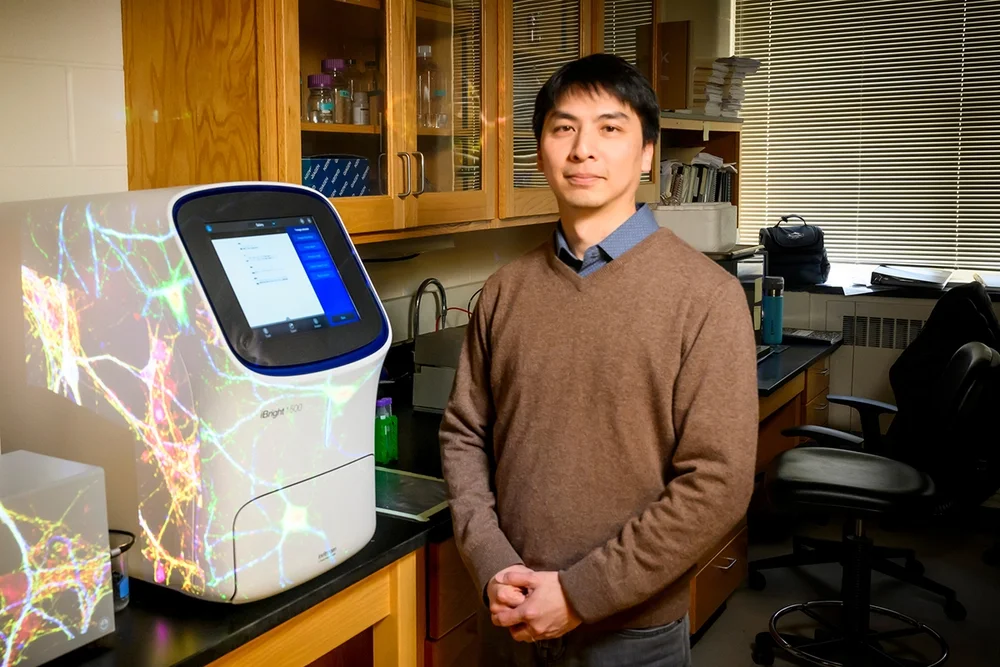
CHAMPAIGN, Ill. — A particular signaling protein in the brain could be a therapeutic target for neurological disorders arising from the deletion of the autism-linked gene MEF2C, University of Illinois Urbana-Champaign researchers found in a new mouse study.
Deletions or mutations to MEF2C are associated with a number of neurological and developmental disorders, from autism to epilepsy to Alzheimer’s disease, said study leader Nien-Pei Tsai, an Illinois professor of molecular and integrative physiology.
MEF2C haploinsufficiency is the term for when someone has only one copy of the gene, rather than the typical two. It is a condition characterized by intellectual disability, autism spectrum disorder and seizures.
“Although MEF2C haploinsufficiency is a rare genetic disorder, the MEF2C protein is associated with many other diseases. Its dysregulation has been linked to many different types of autism,” Tsai said. “By understanding MEF2C, hopefully we can increase the knowledge of not just haploinsufficiency, but many other neurodevelopmental disorders associated with MEF2C.”
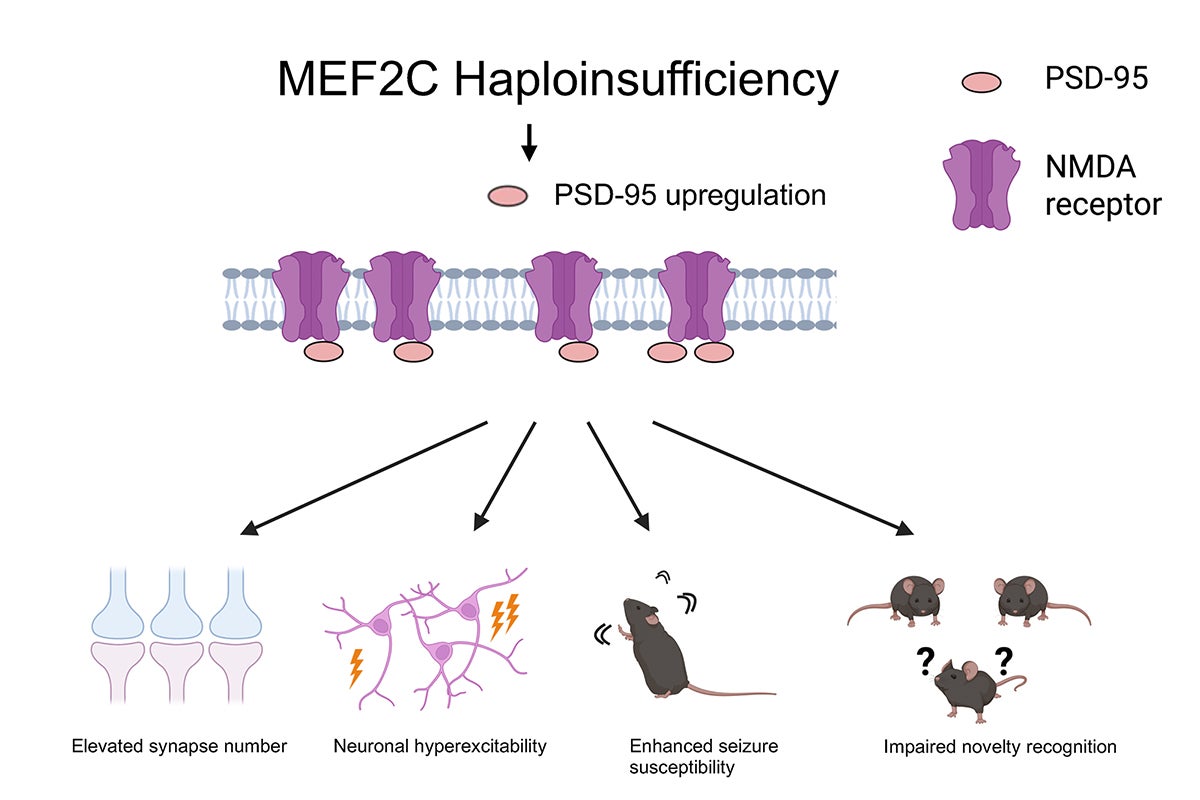
Tsai’s previous work found a link between MEF2C haploinsufficiency and the neural signaling protein PSD-95, which also is associated with epilepsy, Alzheimer’s and other neurological disorders. In the new work, Tsai’s group looked more closely at that link to explore whether PSD-95 could be a therapeutic target for MEF2C deletions.
“MEF2C has an indirect link to regulate the stability of this PSD-95 protein,” said Tsai, who also is affiliated with the Beckman Institute for Advanced Science and Technology at the U. of I. “We assumed that if a patient has less MEF2C, the level of PSD-95 will go up, because it’s not being degraded like it’s supposed to be. We wanted to verify that, and to see what the effect would be if we could then decrease the PSD-95.”
The researchers bred mice with only one copy of MEF2C. The mice experienced profound seizures and cognitive impairments, as they lost their ability to recognize novel objects and recognize new mice socially. The researchers found that the levels of PSD-95 were indeed elevated in the brains of the affected mice.
To determine whether targeting PSD-95 could be an effective strategy for treating those with MEF2C haploinsufficiency, the researchers tried two methods for reducing PSD-95. First, they developed a breed of mice that not only had one copy of MEF2C, but also only one copy of the gene for PSD-95, called “knocking down” a gene. Second, they administered a drug that inhibits PSD-95 from interacting with its receptor in neurons to the mice with MEF2C haploinsufficiency but normal PSD-95.

“Surprisingly, the novel object recognition and the social novelty recognition ability were restored by knocking down or inhibiting PSD-95,” said graduate student Meijin Pan, the first author of the paper. “The severe seizures were restored back to the normal range we see in wild-type mice, as well. That suggests to us that inhibiting PSD-95 could be a therapeutic target to reduce seizures and rescue some cognitive ability in those with MEF2C haploinsufficiency, or other conditions that decrease MEF2C.”
The researchers published their findings in the journal Proceedings of the National Academy of Sciences.
Tsai’s group previously found increased levels of PSD-95 were connected to seizure activity in the early stages of a familial form of Alzheimer’s disease, suggesting that this protein plays a critical role in neural function and that its levels must be tightly controlled, Tsai said.
Next, the researchers plan to further explore the role of the receptor that PSD-95 interacts with, called NMDA receptor, which is a major calcium channel and driver of neural signaling, Pan said. The researchers want to study the downstream effects of excess PSD-95 to identify other possible targets.
“We know that NMDA receptor probably is more active in MEF2C mouse brains, but we have no idea what that might do to the mice. Hopefully down the road we will be able to identify new targets or probably new drugs that can specifically target this pathway,” Tsai said.
The National Institutes of Health supported this work.
Editor's note:
To reach Nien-Pei Tsai, email nptsai@illinsoi.edu. The paper “Hyperfunction of PSD-95 leads to hyperexcitability and cognitive abnormalities in MEF2C haploinsufficiency” is available online. DOI: 10.1073/pnas.2606341123
The National Institutes of Health supported this work through grants R01MH124827 and R21AG071278.